Wednesday, January 1, 2014

The Worrisome Rise of the European Far-Right (Dec. 31st, 2013)


It took only five years for the National Socialist German Workers’ Party (NSDAP), or Nazi Party to rise from having only a few hundred members, to being able to force the president of Germany to proclaim Adolf Hitler — a man whom he thoroughly despised — Chancellor. Hitler’s meteoric ascent to power should serve as a cautionary tale for modern-day Europe.


In late May 2014, over 500 million European citizens in 28 member sates will vote for their representatives to the European Parliament, despite their ignorance of the political climate that is likely to shape the elections and define the composition of this body of governance. In almost every single nation in Europe, far-right parties are gaining ground, and most adhere to the 14 precepts of fascism established by political historian Dr. Lawrence Britt. The situation is not entirely comparable to that of Europe and Germany of the 1930s and 40s. Nevertheless, the rise of these far-right parties, their ties to the economic hardships and austerity measures imposed by the European Union, and the spread of nationalistic and xenophobic tendencies are alarming.
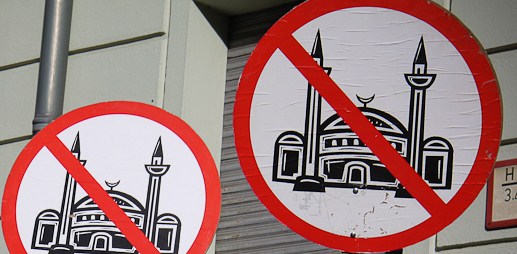


Ethnocentricism and racism rebound on hard economic times.
The far-right parties rely on rhetoric that calls for ethnic exclusion, cultural purity, discrimination for one’s “own people” and against immigrants and asylum seekers, demonization of Muslims and other minorities, and maintenance of so-called traditional values. The threat to national integrity in the face of increased globalization is the excuse used to enact policies and engage in discourse that rely on a fanatical nationalism. The boogieman of the era are largely Muslims and immigrants who are accused of overrunning the clean, pristine, white western supposed democracies with their incredibly high birth rates and “inferior cultural values,” which make them more prone to crime and theft of the natives’ jobs. No mention is made of the continued ghettoization and social exclusion of minorities by the mainstream society and capitalist economy. An irrational fear of the imposition of Sharia law by Muslims on everyone else is often evoked to depict the boogieman.
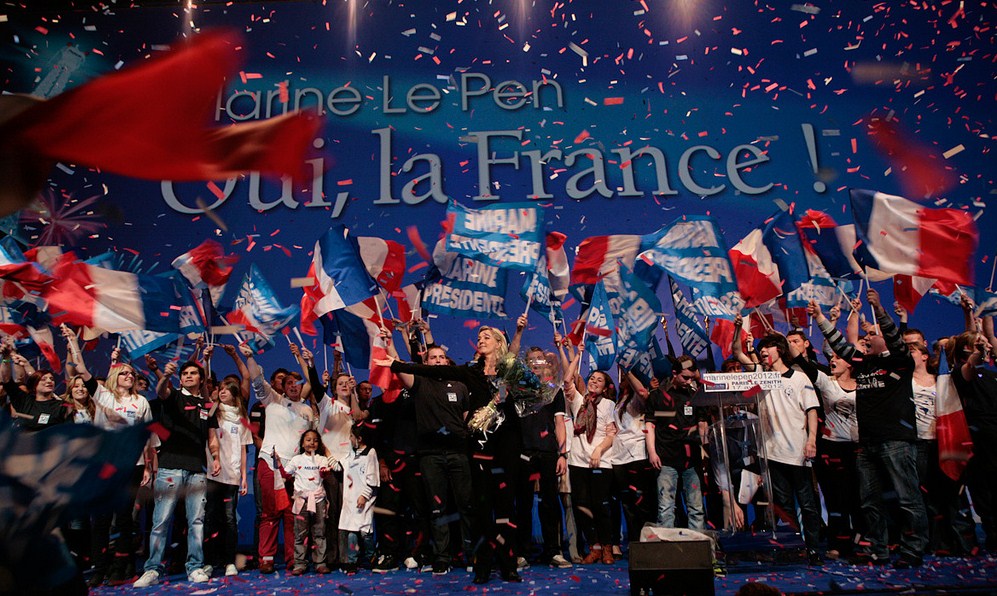


The success of far-right parties and their leaders is strongly linked to economic policies that have plunged much of Europe into a situation of perpetual debt and the socioeconomic repercussions from this. The cause for these parties’ rise is quite evident: in times of economic recession, people try to find a convenient scapegoat for their problems and those of their country. This is especially convenient if the subjects of this prejudice are marginalized, demonized and lacking in recourse to counter the irrational finger pointing and social blame. Scapegoating is yet more convenient if the target groups are second-class citizens, like migrants and refugees, who do not enjoy the same legal rights to protection, whose lives and lifestyles are at risk, and who can be intimidated into silence with the threat of deportation. Thus politicians exploit the fear of an uncertain future due to economic hardship, project it onto a marginalized group or ethnic minority, and use it to ascend to power and impose their ideologies.

To blame only economic conditions for this state of affairs, however, would be too simple and superficial. In many countries, the rise of far-right parties can be tied to a direct failure of governance, as well as historical trends of subjugation and colonization by imperial powers in the rest of the world. In fact, Europe and the rest of the imperialist world have never really addressed the ethnocentric perceptions that lead them, more of less consciously, to believe themselves superior.
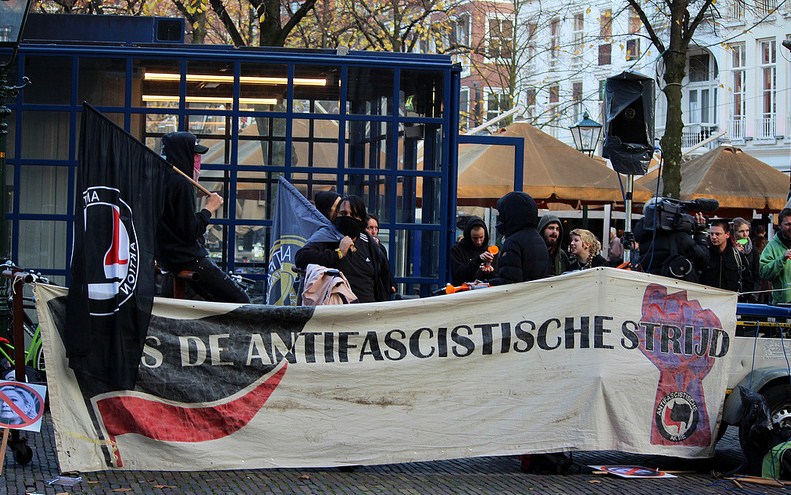


In the Netherlands, the rise of the far-right party is strictly tied to a reinforcement of the notion of a superiority of Dutch white culture, which has been an enduring part of Dutch self-perception. In Greece, the proliferation of racially and politically motivated hate crimes by fascist elements has been largely tied to the complicity of police or their unwillingness to pursue serious investigations of these crimes.

Fascism’s common cross-border strategy
Greece’s Golden Dawn party is emblematic of the sharp resurgence of European fascism, but it is by no means an isolated example. Most European nations, including Switzerland (not in EU), Austria, Finland, Hungary, Norway, France, Denmark, the Netherlands, Belgium, Italy, Greece, and Germany are witnessing a rise in fear-mongering populists from the far-right of the political spectrum, who call for a revamping of national and traditional values and endorse outright racist and xenophobic views. Far from calling themselves fascist or far-right, they categorize themselves as “national conservatives,” “liberal democrats” or simply “conservatives,” or do not register themselves under a political ideology (non-inscrits) to avoid the historical and popular opposition to the term “far-right.” This is the case for parties such as the French Front National, the Dutch PVV (Partij voor de Vrijheid, Party for Freedom), the Italian Fiamma Tricolore, the Belgian Vlaams Belang, and the Freedom Party of Austria.
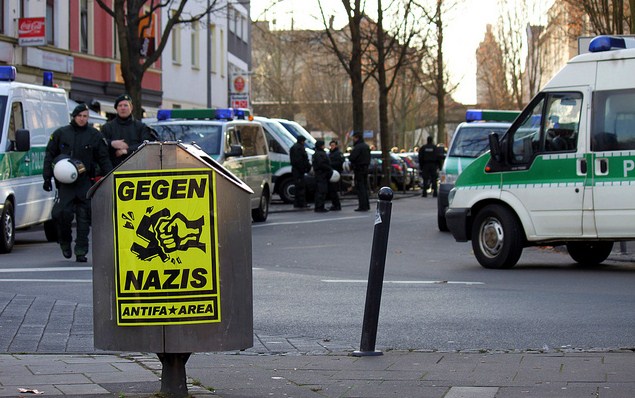


Fascism comes in many different forms but adheres to some basic elements, especially because the political system is most often utilized to manipulate the disgruntled masses. It relies on the perpetuation of popular fears that depend on the local and national contexts. It might even be constituted of workers and laborers, just as in Germany in the 1930s.

Although the European far-right parties may target different groups, all seem to follow a similar model in different contexts. Consequently, they find much common ground to cooperate for the upcoming European Elections. Symbolizing these pragmatic alliances is the collaboration between the Dutch PVV and the French Front National. The PVV is led by the charismatic Geert Wilders (voted Politician of the Year by South Hollanders), and it is currently gobbling on the largest slice of the Dutch popular vote. The Front National is led by Marine Le Pen, the daughter of its controversial founder, Jean-Marie le Pen.

A pan-European alliance joined by hatred and ironically against the EU
Marine Le Pen and Geert Wilders met on November 13, 2013 in The Hague to discuss how to cooperate in the creation of a pan-European alliance. On one hand, Wilders often criticizes Muslims for their homophobic attitudes and — at least for now — he prides himself on tolerance of sexual freedom as being one of the fundamental liberal values of the Netherlands that he and his party represent. On the other hand, Marine Le Pen has vigorously fought against the recently voted gay-marriage laws in France. While Wilders speaks of the “Christian-Judeo culture” of the Netherlands, Marine Le Pen is suspected of antisemitic attitudes, and her father is an expressed antisemite.
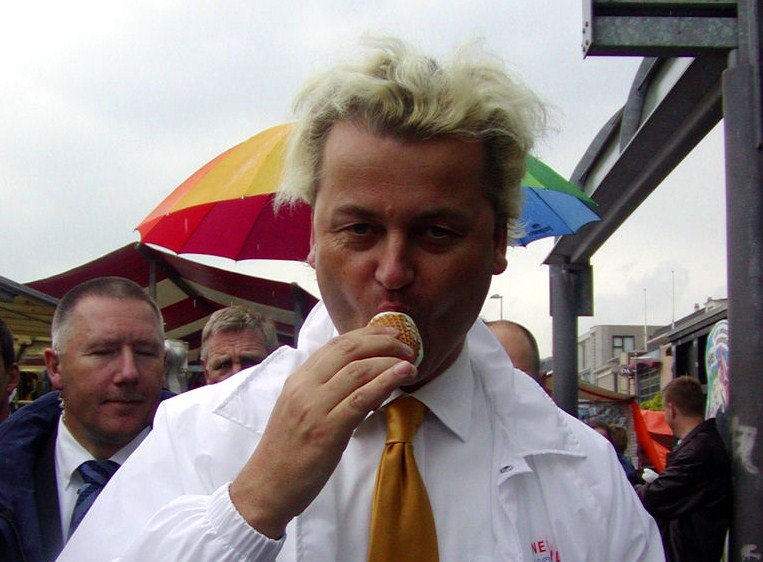


Despite these fundamental differences, Geert Wilders and Marine Le Pen have no qualms about cooperating in a power grab at a European level, which would allow them to further their ambitions for power on their respective national stages. Both are aware of each other’s use of fear tactics to manipulate their support base, with the scapegoated minorities being north Africans and Africans, some of whom are Muslims. Both also claim to be the paladin defenders of their Christian and national white values and to abhor those of migrants, although they seem unable to reach a consensus on values such as acceptance of sexual freedom in the Netherlands versus the adoption of Catholic gender roles in France. Le Pen’s ideology recalls the “Travail, Famille, Patrie” motto of the Nazi collaborators of Vichy France.

Other far-right parties across Europe are also collaborating with each other. Ideological minutia are not the subjects of discussion and discord in such deliberations. Rather, the establishment of a fascist system of political manipulation is the common goal, and fear-mongering is the common strategy. Despite being rhetorically largely anti-European and even calling from an exit of their respective nations from the Euro-zone, these parties had no compunction in banding together in late 2010 to launch a European referendum to “protect the union” by preventing Turkey‘s entry in the EU. Later, in December 2010, Heinz-Christian Strache (chairman of the Freedom Party of Austria), Belgian politician Filip Dewinter (Vlaams Belang), Kent Ekeroth (of the nationalist and anti-Islamic Sweden Democrats), and René Stadtkewitz (German Freedom Party) went to Israel to meet with Jewish settlers in the West Bank, and discuss “strategies against Islamic terror,” before being hosted as honored guests at the Israeli Parliament. United in their hatred for Islam, these parties have found much ground for cooperation at a European level.
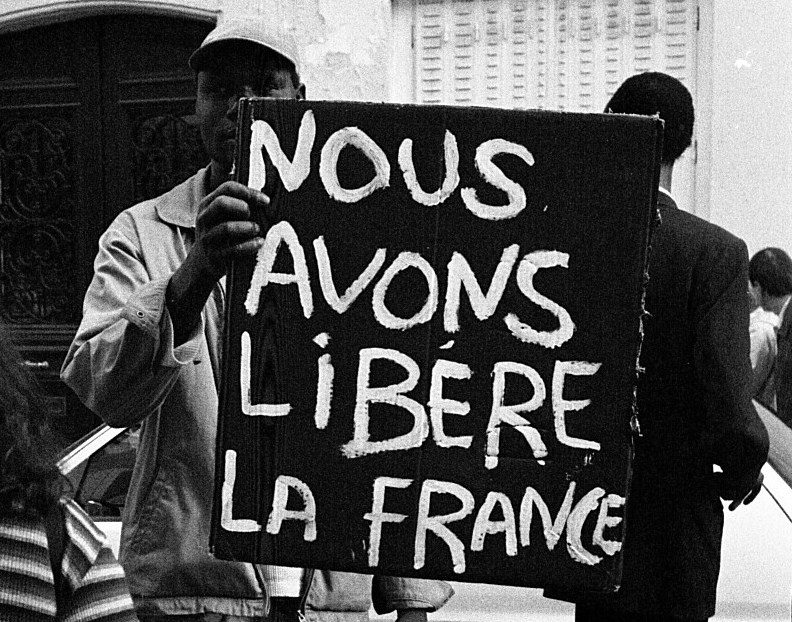


This is not the first time that far-right parties in Europe have attempted to cooperate. In 2007, for example, various parties, led by France’s Front National, banded together to create a pan-European far-right alliance called “Identity, Tradition and Sovereignty.” Jean-Marie Le Pen also tried, between 1989 and 1994, to create the “Technical Group of the European Right.” Such attempts were often short lived and relatively unsuccessful, since they were consistently marred by internal disagreements. This seems to be changing.

Birth of the fourth Reich?

Far-right parties are continuing to encroach on and infiltrate the European political landscape. When one looks at the European Parliamentary elections over the past years, one immediately notices a consistent erosion of the socialist and leftist groups (and the ones remaining are, in any case, milder versions of their predecessors), which might also account for the rise of parties and political entities on the opposite side of the political spectrum. This rise of the far right is not immediately apparent, but it can be seen if one compares the number of seats held by such parties in the European Parliament, and the number gained since 2009 in their national governments’ parliaments.
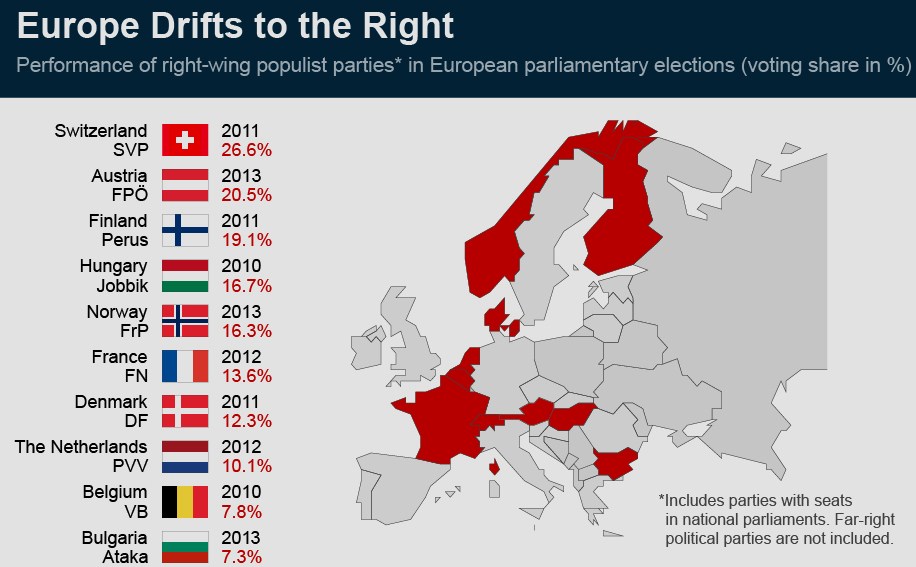


In Italy, the Lega Nord (Northern League) already controls most of the northern regions as well as nine out of Italy’s 73 MEPs. The Dutch PVV is Europe’s far-right rising star, going from holding 5.9 percent of the electorate in 2006 to 15.4 percent four years later, and to now being placed by many polls as the most favored party in the country. France’s Front National is also enjoying enormous success, as 42 percent of French citizens would consider voting for it at the upcoming municipal elections, and polls currently place it in the lead for the European Elections. Golden Dawn has the majority of voters galvanized in Greece and is poised to achieve similar results in the upcoming European parliamentary elections. The Danish People’s Party is the third largest in Denmark and steadily rising in polls. Similar trends are apparent in Northern-European countries such as Finland and Norway, as well as Eastern-European countries such as Hungary, Bulgaria and Poland.

The European elections in May 2014 bring to mind a few questions. Will the far-right get set on its way to further its agenda and increase its prominence? Arguably, the 1929 Wall Street crash that triggered the Great Depression brought along Adolf Hitler as one of its nastier side effects. Will the current austerity measures and economic turmoil across Europe be allowed to bring a modern-day, international version of the Nazis?


Original Article: http://newsjunkiepost.com/2013/12/21/unification-of-europes-far-right-rise-of-the-fourth-reich/

Sunday, December 15, 2013

Apartheid Promoters Eulogize Mandela

Note: This is an extended version of the article published on December 6th, 2013 on the News Junkie Post - your reliable source for independent in-depth geopolitical analysis.


While last night and today, since his death, world leaders have been eager to jump on the bandwagon of the mourning of the death of a great man and freedom fighter, Nelson Mandela, they eulogies reek desperately of self-absorption and propaganda purposes. While a rare few may be sincere, the vast majority of spoken and written words by prominent world leaders revel their enormous hypocrisy, and their willingness and ability to attempt to manipulate any situation, no matter how grievous, to their advantage. Although these would comprise the vast majority of world leaders, three examples are too blatantly hypocritical to ignore.

Obama – Wolf in Sheep's Clothing

Minutes after brother Mandela's death was pronounced, President Obama was quick to take advantage of the situation to use a great man's legacy to further his personal image and ego, as well as his disguise as a wolf in sheep's clothing and reinforce his imaginary persona of a humanitarian who only takes military action as a last resort and with deep regret.

While Obama engaged in offering his hollow praises to Mr. Mandela and his ability to “ben[d] the arch of the moral universe towards justice”, he himself is engaged in a war of aggression in Afghanistan, an occupation in Iraq, drone bombing operations resulting in thousands of civilian casualties in Yemen, Pakistan, Afghanistan and Somalia, a siege against Iran, provocations against North Korea, a continuing embargo against Cuba as well as the failure to close Guantanamo Bay camp, and has even resorted to the assassination of U.S. Citizens abroad.


While President Mandela has fought for justice and emancipation of oppressed people worldwide, including the Palestinians, President Obama is responsible for the oppression and death of thousands of innocents worldwide, including Palestinians. Under his rule and supervision, the Obama administration is responsible for financially, morally, politically and militarily aid the terrorist state entity that is Israel, and provided Egypt with the military equipment, training and supervision to destroy Gaza's lifeline to the world – the underground tunnels.

While Mandela actively sought and campaigned for greater unity and solidarity amongst the people in Africa, the United States continues

Obama is not alone in the list of U.S. Presidents who praised the recently defunct South African leader. Bill Clinton, who maintained President Mandela on the U.S. Terrorist list during his two presidential terms, recently tweeted “I will never forget my friend Madliba”. In fact, South African activist Father Michael Lapsley revealed in a thorough interviewregarding the role of the U.S. In the support of the apartheid government he noted:

"The dominant view is that the U.S. was on the right side in South Africa, that it opposed apartheid. But nothing could be further from the truth, particularly when Reagan was president. Reagan labeled the African National Congress (ANC) a notorious terrorist organization, while continuing Washington’s support for the apartheid regime." Michael Lapsley

It is also important to remember that although the United State's rhetoric may be embracing and friendly towards Mandela, due to its enormous popularity, it was deeply entrenched in the suppression of African liberation movements during the Cold War. The United States' arch-enemy and neighbour, Cuba, instead provided enormous military but especially educational, medical and humanitarian aid to African liberators such as Patrice Lumumba in Congo, Sam Nujoma of Namibia, Ahmed Sékou Touré of Guinea, Julius Nyerere of Tanzania, Samora Machel in Mozambique. Perhaps most importantly in this regard, however, may be Cuba's support for Agostinho Neto and the Popular Movement for the Liberation of Angola (MPLA) in Angola's war of independence. In fact, the 36,000 armed Cuban troops and over 300,000 civilians (doctors, teachers, engineers etc., of which nearly 2,000 lost their lives) that Cuba providedto Neto and the MPLA were instrumental in defeating the invading army of the South African apartheid government attempting to overthrow the newly established independent government, backed by the CIA. While backed by the United States and Britain, Cuba's contributionto South Africa's defeat also considerably contributed to the weakening of the apartheid regime, and its eventual defeat by Mandela's African National Congress.

Mandela and Castro meeting in South Africa for the first time
since Mandela's release from prison.


Had it not been for the Cuban presence in Africa and in particular in Angola, the history of Africa would have never been what it is now. One of the greatest friends that Cuba has is nelson mandela because of the appreciation of what Cuba did and Fidel Castro” - Harry Belafonte

Cameron – The False Prophet

David Cameron also has engaged in some hypocritical propagandist appropriation of mourning for a great person's demise by posting eulogistic tweets boasting that he would order the flat at Nr. 10 to be flown at half mast. Most of us, many of my acquaintances as well as myself were not even born at the time, and hence do not remember that in 1985, while Cameron was one of its top members, the Federation of Conservative students produced the now infamous “Hang Mandela” poster following the rhetoric of Margaret Thatcher that the now world renowned freedom fighter was a “terrorist” (while insisting dictator Hugo Pinochet was a champion of democracy).

Nelson Mandela's portrait being used in the now infamous
 "Hang Mandela" poster.


Although Cameron has utilized the apology for Thatcher’s support of the South African Apartheid regime one must not forget that he was not simply marginally involved in one incident related to this issue, as it could be misconstrued from the aforementioned anecdote. Four years later, in 1989, and towards the end of the Apartheid regime, Cameron was an enthusiastic member of an anti-sanction fact finding mission on behalf of the Tory Policy Unit. The mission was undertaken with the direct participation of a lobby that was directly sponsored by then South African president Pieter Willem “The Big Crocodile” Botha.

Netanyahu – A Devil with a Forked Tongue

Most appalling of all the insincere eulogies, false praises, and spoken words/written lines in remembrance of Nelson Mandela must have come from the deranged prime minister of the equally insane state of Israel. As the leader of a government which not only has continued, but indeed exacerbated, the Israeli military occupation and civilian colonization of Palestine and the creation of an apartheid state, you would expect Netanyahu to take the moment to reflect on Mandela's relentless support of the Palestinian people and their cause for self determination. Not so.

Translation: "Nelson Mandela was a main figure of our times. He was a father with a vision and many choices. He gave a personal example with his [visions] as a freedom fighter, and a very humble man. he worked to heal the defragmentation of society within southern Africa to prevent outbursts of racial hatred. He will be remembered in the new South Africa as a moral leader."

Carefully avoiding to mention the word “apartheid” in his written message, which would have evoked too many links with the current plight of the Palestinians in Israel and the Occupied Territories, he still managed to manipulate Manuela’s death to his advantage. Referring to him as “He was a father with a vision and many choices [who] gave a personal example with his [visions] as a freedom fighter”, Netanyahu attempts to gift-wrap his words as a testament to his adherence to the moral values and principles promulgated by president Mandela, while nothing could be father from the truth. Lest we forget, it was a much younger Nelson Mandela who in a warm day in Praetoria on December 4th, 1997, declared that “I have come to join you today to add our own voice to the universal call for Palestinian self-determination and statehood. We would be beneath our own reason for existence as government and as a nation, if the resolution of the problems of the Middle East did not feature prominently on our agenda... We know too well that our freedom is incomplete without the freedom of the Palestinians”.


Under “Bibi” Netanyahu, Palestine has witnessed the expansion of the illegal Jewish-only settlements invading Palestinian soil, the increased fractionalization of the Occupied Palestinian Territories into self-contained and almost inaccessible cul-de-sacs by the Israeli state, the continued building of the segregation wall, a military offensive against Gaza resulting in over 160 civilian deaths, the familiar sabotage of consequent peace negotiations, and the currently ongoing siege of the Gaza strip... amongst some.

Mandela is probably turning in his own grave, even before it has even been dug.


Thursday, October 24, 2013

Trick or Treat? Turkey's Revolutionary Conundrum

"Things fall apart; the centre cannot hold;
Mere anarchy is loosed upon the world,

The blood-dimmed tide is loosed, and everywhere

The ceremony of innocence is drowned;" 
- William Butler Yeats (1865-1939)


Trick or Treat? 
Turkey's Revolutionary Conundrum

The current uprisings in Turkey have been characterized by many as being a clash between the pro-Islamic social conservative forces led by Turkish PM Tayyip Erdogan and his Justice and Development Party (AKP), and the secular demands of the urban Turkish population.

To characterize the current struggles in this dichotomy, however is extremely dangerous. Not only it reinforces a western orientalist perception that followers of Islam as being inherently irrational and despotic, but also simplifies the issue while failing to address the greater, complex, and more fundamental flaws with the Turkish political landscape. Although resistance against the social conservative and Islamic-inspired policies or Tayyip Erdogan have been influential in adding to the outrage of the current protesters and the general public, and which portrays the current government as an exceptionally authoritarian, limiting oneself to this rhetoric provides only an incomplete narrative. 

The current AKP government is, in fact, the latest expression of a long tradition of authoritarian and patriarchal regimes which have been at the rule of the country since the establishment of a secular Turkish republic by Kemal Ataturk in 1923. Similarly, it could be said that the protests are not new in their expression of discontent against this tradition, and the violence with which the Turkish government has attempted to quell the protests is also not a new phenomenon, but represents a familiar policy of suppression and oppression of those groups, whatever their political and religious affiliation, which threaten the authority of the state and the government. In fact the protests are not, at their core, a conflict about Islam vs. Secularism, but a categorical refusal of a patriarchal and exclusionary system of governance. The Islamization policies of Tayyip Erdogan have simply been, for many, the spark that ignited the kindle of discontent.

The Demographics of the Protests 

One of the most impressive aspects of the Taksim/Gezi protests and their nationwide expression is the wide variety of demographics and political affiliations which compose the protesting groups. Starting with environmentalists, who were the ones who initially refused to allow the trees of Gezi Park to be cut down for the gentrification process of the area, the expression of discontent with the current government has galvanized and involved socialists, communists, anarchists, LGBT, anti-capitalist muslims, kemalists and many others in a wide constellation of political interests with one common line - the erosion of power of the AKP. The motives behind this erosion however differ from group to group: while the kemalists are simply utilizing the protests to discredit and weaken their greatest political adversary for the benefit of the Republican Party (CHP), other interests are more reformists in advocating change within the current political system, and the more radical ones (comprising a large part of the protesters) instead are eager for a complete dismantlement of what they percieve as an inherently unjust and unbalanced system in favour of a more inclusive and participatory socio-political arrangement.

It must be noted that Turkey's current pseudo-"democracy" in fact is quite exclusionary. Numerous laws prevent the establishment and consolidation of interest groups and parties which do not fall within the CHP and the AKP, and which prevents minority groups and interests to have an voice in the determination of the affairs of the nation. Most notoriously, a law which prevents the consolidation of any party without a minimum of 10% prevalence within the population has come under particular scrutiny, as it effectively prevents smaller parties and minorities from entering the political arena, and for the popularization of their ideals.

Within the extremely restricted spaces offered by the current Turkish political system it is not surprising that many of the smaller and more radical groups involved in the struggles have adopted the only pragmatic (and ideological) stance that would allow for that freedom to be expressed - a complete dismantlement of the system and its reconstruction into a participatory democratic process. The point upon which many of the involved protesters, groups, and political ideologies differ however is how to achieve such a feat. 

Alternative Governance

Following ninety years of iron-fist military rule which resulted in three coups (in 1960, 1971, and 1980), and a decade of oppressive AKP rule, the urban Turkish population has realized that there is little hope for genuine democratic participation in a system that is inherently flawed and, for the first time in Turkish history, the masses are questioning how to organize themselves to provide viable and alternative way of expressing their hunger for democratic participation.

How would one envision the socio-political arrangements of post-revolutionary Turkey? The foundations of these arrangements have already been laid in the establishment of the over seventy-two popular forums which are scattered across the country and are present in almost every major urban centre in the nation. Although locally focused, these already existing participatory democratic structures could quite easily be expanded to provide a national framework of decision-making similar to that of the people's congresses which, until the disastrous NATO operation which culminated in 2011, ruled the nation of Libya, or to the neighbourhood Centres of the Revolution (Centros de la Revolucion - CDR) in Cuba. The main difference between such examples and the Turkish popular Forums, is that the latter do answer to a central governing body.

At this moment, the Forums are only dealing with issues related to the current struggles and protests, but have the ability to be much more. It should be taken for granted that the more established political interests will not allow such a governance system to cement itself in the mainstream institutional political arena, and it is unrealistic to expect those same interests to magically and spontaneously adopt such a system themselves. What is prossible is that, should their existence and support endure, these forums could establish an alternative and parallel system of governance that could, in time, erode the legitimacy of the centralized institutionalized government and the parties affiliated with it. That is to say that little by little, step by step, and with the strong support of the population these forums could expand their decision-making authority to a wider variety of issues, and eventually set up their own "governmental" apparatus. The more such legitimized and popular authority grows, the more that of the established institutions is eroded. Entire areas of the large urban centres could be effectively become self-managing communes under the control of the protesters where decisions about their affairs are decided in the forums.

In order for such a grand democratic project to be successful however, the Forums must seek to expand their influence and support not only amongst those already convinced of their utility, but to those who may even currently be contrary to it, and other marginalized and dispossessed segments of society. The leftist revolutionary movements have the possibility to benefit from the outrage of those who don't necessarily agree with their ideological line to advance their struggles and attempt to coax those opposing voices into their own ideological sphere through this democratic process. At the same time, such groups have to be careful not to compromise upon their demands and ideology for the sake or garnering support from those who still adhere to an institutionalized conception of governance. 

Although seemingly far fetched, the protests have already had similar effects. Through a common line of discontent, groups and individuals who never stood in solidarity with each other, and thus were mutually antagonistic,  had the chance to interact for the first time. This interaction between marginalized as well as more mainstream groups has profoundly affected the perceptions of those involved in the struggles, as they learnt to view those groups as other humans with something in common, rather than "others". This has been largely the case for the Kurdish minorities, as well as the LGBT population whose acceptance amongst the protesters (despite initial hesitations) is now almost unconditional.

The Role of Unions

Despite the relatively weak positioning of worker's unions in the Turkish political landscape, their participation in the nationwide protests has been instrumental. In Taksim, union workers were the first to "teach" the younger and less experienced protesters how to build effective barricades against the police's armoured vehicles. As a protester whom I met mentioned

"First when there were only environmentalists it was ok, but you know, we were just sitting around and passively resisting arrests, and it wasn't working. When the workers and the football team supporters started to come down, they knew what they were doing! Hahaha. You see those fences [pointing]? They could dismantle them in just a minute, and bring them over and create barricades against the police. And that's when we really started putting up a resistance..."

Despite this initial sign of support, unfortunately, there has been little subsequent and explicit interaction between the bulk of the protesters and the worker's unions. In order to put real pressure on the government, however, this relationship must be revitalized and capitalized upon.


Friday, October 4, 2013

What it Means to be LGBTI in Istanbul - Experiences at Kadiköy Forum


The uprisings in Turkey have had many repercussions, but one of the most impressive and potentially long lasting effects it may achieve is the creation of a feeling of solidarity among the marginalized social and political groups. Through a common line of discontent, groups and individuals who never stood in solidarity with each other, and thus were mutually antagonistic, had the chance to interact for the first time. This interaction between marginalized as well as more mainstream groups has profoundly affected the perceptions of those involved in the struggles, as they learnt to view those groups as other humans with something in common, rather than “others”. This has been largely the case for the Kurdish minorities, as well as the LGBTI population whose acceptance amongst the protesters (despite initial hesitations) is now almost unconditional.

Despite this, the LGBTI movement in Turkey is far from being accepted in the mainstream social and political discourse and LGBTI persons still face enormous prejudice in society at large. In effect, by European standards, the movement is still in it infancy, having only officially begun in 1993 with the establishment of Lambda Istanbul, the first LGBTI organization in Turkey, and having only made baby steps until the past couple of years. Since then, there have been numerous small but fast-growing Pride parades – starting with a mere 30 people in the first parade in 2003, and eventually growing to 5,000 participants in 2010, tripling to 15,000 in both 2011 and 2012 supported by the BDP (Kurdish) and CHP (Kemalist republican) parties, and culminating with an estimated 100,000 attendees in 2013 as the pride parades were joined by the Gezi Park protesters.

Istanbul Pride 2013.
Photo Credit: Everen Kalinbacak 

The Forums that have been establisher across the country, however, are making enormous effort to educate the Turkish public at large about the struggle of LGBTI persons. I recently attended an expression of such effort in the public forum of Kadiköy in the form of a public forum and workshop. People of all ages and social and political denominations attended the event in Yogurtçu Park, attracting the attention of many heterosexual families and citizens nearby, who eagerly stopped to listen. I witnessed people with bags full of groceries stop and listen on they way back from their shopping, and ambulant vendor disinterestedly leave their stalls to pay attention to the workshop.

A passing-by shopper stops to take listen
to the public speakers of the workshop.


One of the most striking aspects of the workshop was how eager and open the attendees were to share their views, and yes, their fears and preconceptions, in public for them to be confronted and deconstructed. Even the event moderator was moved by the eagerness of all present to share their opinions and experiences, and at how open the meeting was. “This could not have happened a few months ago” she mentioned, alluding to the act of re-taking the public spaces by the public to engage in serious and seriously needed social and political commentary. “This should have happened ten years ago”, mentioned one of the older ambulant sellers in the park, who had abandoned his bread nearby to take part in the workshop.

Another striking aspect was however, from a European perspective, was how basic (however, incredibly honest) the conversations were. The workshop began with the moderator asking the attendees whether they believed that homosexuality was an illness or a psychological dysfunction, and addressing the responses. She made mention that the American Psychiatric Organization had declared homosexuality not to be a psychological dysfunction in the 70s, and the World Health Organization had followed suit in the 80s declaring that it was not an illness. The workshop proceeded with both heterosexuals and LGBTIs sharing their thoughts and experiences.

“I have no problems with homosexuals, but when I see a transgendered person, I am bothered and annoyed” one of the attendees honestly admitted, eager to be educated on the source of his prejudice and how to overcome it. Many people, in fact, stated that they had overcome their preconceptions thanks in large part to friends who had come out as homosexuals, but that when friends came out as transgendered, they didn’t know how to relate to them in their “new” gender. “The different attitudes towards the different genders, the dualistic gender perception and roles, as well as gender relations is indeed part of the problem”, was stated by one of the attendees. Furthermore, it was pointed out that transgendered suffer from disproportionate discrimination, even by homosexuals themselves, who see their sexual disposition as natural, but consider transgenderism as a non-natural perversion.

Finally, many of the homosexual people present spoke out about their decision to come out and the repercussions that they experienced. “I came out six months ago;” says a young woman, “and since then my father has been writing suicide letters”. Others also capitalized on both the negative and positive aspects of “coming out” publicly. Often, they insisted, it results in ostracism both by the community at large as well as the LGBT community which hasn't “come out” yet, due to fear of being associated with that person. On the other hand, the act of coming out, especially to one’s parent and friends, proved to be an asset when being the victims of hate crimes. One attendee in particular capitalized on this: “I was once attacked by a man on a motorbike for being gay. When I went to the police station to report the crime, I realized that because I hadn't come out I had nobody to help me and support me. I ended up not reporting the crime out of fear that, alone, doing so would have made the situation worse, and I could have suffered abuse by the police itself”.


The attendees were so eager to share their experiences, that the workshop went on much longer than expected, and prevented the timely screening of the film “My Child” by Turkish director Can Candan and intended to document the reactions and attitudes of parents of LGBTI persons in Turkey. Indeed this was prevalent topic also in the discussion – many of such parents, members of an organization for parents of LGBTIs in Istanbul, attended the workshop and spoke out. Many stated that they “came out” as parents of LGBTIs with their children, to support them in their choice, while others admitted that their process of acceptance had been much more tortuous. All of them however expressed the same sentiment: “You shouldn’t treat your child as a son, or as a daughter, but simply as your child, period. Don’t try to change your children, but accept them and support them for who they are.”

Feminist Protests in Istanbul

On the night of September 24th, a group of very brave (and very loud) Turkish women of all ages and political denominations took the street to condemn the patriarchal government of Tayyip Erdogan.

They took the streets to protest the social-conservative policies of the AKP government which is eroding their human and women's rights, including access to abortion.

They took the streets to protest the illegal and intimidatory practice by the police to strip-search naked the women who are detained for taking part in the demonstrations.

They took the streets to refuse the traditional gender roles that would see them staying home, cooking, and having three babies (Erdogan has suggested that couples should have at least three babies).

They took the streets to protest the rape and sexual abuse suffered by women and carried out by the Police (a 16 year old girl was raped by six policemen in a police van after being arrested a week prior - not the sole incident). 


I don't often cite Amnesty International as I believe them to have a political agenda very tightly linked to that of imperialist nations. However, in a recent report they have released on the Gezi Park and related protests, substantial evidence was disclosed about the verbal and physical sexual harassment against women by law enforcement officers and the testimonies of (not the only) two victims. 

Being the ONLY man actually in the protest (except for the the mostly-male press that was filming and photographing and two guys following the protest from the sidewalk) felt strange, but very natural. It was also a very refreshing sight to see the residents of Kadiköy applaud the efforts of these women, and spontaneously joining the protest which grew from about 120 to 200 people as we marched through the Moda district.


They stopped traffic on the busiest road of Kadiköy and towards the end, the situation got very tense when the women confronted the police face to face screaming "Katil Polis!" (Police, assassins!). The Press placed itself between the police and the protesters as a buffer to protect the women from eventual attack by the "law enforcement" officers, which luckily never came.


Erdogan has seriously chosen the wrong generation and the wrong women to fuck with.


Wednesday, September 18, 2013

Reflections on Turkey - Part 1 (Testimonials)

Towards the end of May this year, Turkey was shaken by massive protests which began with the attempted defense of Gezi Park, in central Istanbul, from a gentrification project. What began with roughly only a dozen environmentalist activists, turned into a full-fledged movement that encompassed every major urban centre of the nation.

I recently travelled to Istanbul to meet with numerous activist groups, of all denominations and political convictions, to get a better impression of the current developments of the Gezi Park/Taksim Square protests and movements, and what they entail for the future of Turkey and its political landscape. As such, this investigation is divided in two sections: This first one will report on the testimonials of both activists and supporters of the Erdogan government, to convey in their own words their beliefs. The second part will be a socio-political and geo-political analysis of the situation, based in part on these testimonials and my own personal observations.

Disclaimer: The opinions expressed by the people interviewed do not necessarily reflect those of the author and have been collected purely for documentation purposes.
_________________


Manuel - Manuel is a Spanish activist and a student of Art Science in the Netherlands. Having been heavily involved in the indignados  and 15M movement in Spain, he came to Istanbul as a show of solidarity with the protests nearly two months ago. As we are discussing, Manuel and I are walking from Galata Tower, through the Istikal Cadessi, up towards Taksim square and through Gezi Park.

"These days you will not see many protests in Taksim. Unfortunately, the police violence has been simply too much to deal with for the protesters, and they have had to relocate. We had use humour to deal with the violence though, to keep our spirits up, like when we appropriated the term 'Çapulcu' that Erdogan called us. You know, we made it ours. There we also many chants and songs made about [tear] gas: 'Gas Gas Gas, We Want More Gas!'.


A gas-masked protester (Ziya Azazi) performing a traditional Sufi spiritual dance in Gezi Park.
One of the amazing things about the Taksim protests is that they brought together all different groups. When I was in Barcelona and was taking part in the indignados movement, yeah there was support from all over the country, but there was no single-ideology present either no flag, there was an idea of an ‘Anonymous’ movement with no faces and no colours from any political side. Here instead the people of Taksim are very different from each other and every single flag was represented on the park, from the neutrality and no political images of the İndıgnados to the multı-coloured all-kind of images and political signs of Gezi.

You know, there has been a long and very hard rivalry between the three football clubs in Istanbul. Have you heard that? Well, for the first time ever the three football teams of Istanbul, who had always been bitter enemies and their ultras often got into fights, came together in support of the Taksim protests. They were holding each others arms shouting chants of unity and support, each with their football team's shirt. It had never happened before. And you know it's not true that it is an anti-religious movement, as there are many anti-capitalist Muslims in the movement and we have celebrated many Muslim holidays together, and have done Iftar during Ramadan.

It was a surreal experience, you know. When we managed to push the police and march through here [Istikal Cadessi], we'd have to break the tiles to have rocks to throw at them. The shop owners supported us, and sheltered us, and the police often broke their windows as intimidation and to blame it on the protesters. Sometimes they also used infiltrators and agitators. People would spray graffiti all over these walls. During the night when nobody was around, entire teams of people from the government would come, clean the place up, replace the tiles, and re-paint the walls - here, where you see that gray paint, that's where they repainted. It was to give the illusion that nothing had gone on.

The police would be waiting in the smaller back-alleys, waiting for protesters fleeing the gas to ambush them and arrest them, and bring them to prison after having beaten them in the vans."

As we walk up towards Taksim, Manuel explains to me why the square is of such symbolic value to the people of Istanbul.

"Taksim square used to be the water distribution centre for almost the entire city. The cisterns on the other side [of the Golden Horn] were for the rich and the Sultans. This is where the people came to get their most precious good for life, water. It is Ironic that the capital of three empires which had potable water hundreds of years ago now does not anymore. It is because of the dams that they have built on the rivers that used to bring the flow of water here. The flow has been largely interrupted because of the dams, and the city now has to get its water from other sources, which are not drinkable. So, now we have over 15 million people who have to drink from plastic bottles every day.


Here we are at Gezi Park. During the protest this place was amazing. First when there were only envıromentalısts it was ok, but you know, we were just sitting around and passively resisting arrests, and it wasn't working. When the workers and the football team supporters started to come down, they knew what they were doing! Hahaha. You see those fences [pointing]? They could dismantle them in just a minute, and bring them over and create barricades against the police. And that's when we really started putting up a resistance, when the football team supporters started to join us."

We take a seat to finish our food on the steps overlooking the fountain.

"You see over there? Those projects are continuing, they are for the creation of the car tunnel. We don't know if they will continue with the other projects, but they probably will. They are just waiting. When things were bad around here, there were supporters of the government that took advantage of the confusion to beat up people. They say that five people died in Istanbul, but I think it is much more. It's just that the families did not want to admit that their children had died in the protests to avoid political repercussions, and the media attention. Some bodies have just been found dumped in isolated areas.

When we controlled the park, here was the park's library [near the fountain], before they took it away. Now, all over the park there are undercover cops. The problem is that you know, in Europe you can tell an undercover cop at. They generally dress in black, with shades, and they are quite muscular. Here they had to recently double their employment of policemen, which means that they have taken in a lot of young people. So, they look like simple, normal people, almost like students, and it is hard to tell them apart. 

I ask Manuel what role has the Kurdish population played in the uprisings, since the peace process initiated by Erdogan and the consequent recognition of the Kurdish Language and limited autonomy was seen by many Kurds as promising. 

"The Kurds have mostly supported the protests. They recognize that the peace process is just a smokescreen to pacify them. And although they will take that over nothing, they realize Erdogan's authoritarian nature, and they know it won't last long. Plus, the violence that we have experienced here is nothing compared to the sustained repression and violence that they are accustomed to.


_________________

Sven - Sven is a journalist working for a local socialist newspaper. When I met him he apologized for not having been able the day before, as he had to go to the hospital, and had an operation the day after we met. I would never imagine why until towards the end of our conversation.

"The first thing that people have to realize is that the current Taksim phenomenon is nothing new. Despite only being now picked up by the international media, Taksim has been a symbol of resistance and defiance against the state for nearly forty years. The first death in Taksim due to a demonstration took place in the first even May Day in 1976, when a protester was found with his cut throat in a side alley. But this was just the beginning; the following year the fascist Turkish security forces armed and aided by their US masters opened fire on the May Day demonstration, killing over 34 people. Since then, the Turkish government has decreed that gatherings in Taksim were to be illegal. Every year since then, however, May Day demonstrations have taken place in Taksim in defiance of the order, and usually ending in police violence." 


The 1977 Taksim Massacre


As we walk up the street from Galata Tower, we take a seat in a Koftë stall, and we order vegetarian Çig Koftë.

"Did you know where the largest May Day celebration was in 2012? The largest one was in Havana, Cuba, while the second largest one on the planet was held here, in Istanbul, but nobody talked about it then! The current Taksim protests are actually nothing new, they are just a new expression of a traditional phenomenon in Turkey. This country is still run as a feudalistic system which needs to be dismantled before a socialist revolution. But you cannot achieve a socialist revolution without having laid its foundations. 

So, in order to go through a socialist revolution, a country that is still in a feudal arrangement such as Turkey must go through a democratic revolution, and that is Taksim square. Then, to achieve a socialist revolution, the population will have to go through the concepts of Maoism  and establish a dictatorship of the proletariat."

I ask Sven about his activities as a journalist and whether those affect his experiences at protests.

"Well, Turkey is the country with the highest number of journalists in prison. I work for a socialist newspaper and so naturally they are watching me. Of course because I am a foreigner I have some protection, but that doesn't mean that I can't be arrested, tortured and then deported back to Germany, or that a bullet will not hit me when the police shoots on protesters."

Do they use live bullets?!

"Of course they use live bullets. They have no problems using real bullets. NO PROBLEM [he emphasized]. The only reasons they are not using real bullets against the protesters in Taksim is because they know that the international media is watching. Turkey has had a series of fascist governments in power since memory can recall, and now with Erdogan it is just a different brand of fascism, one which is not 'secular' and military, but that is 'Islamic' and maintained by the police. There is no real difference, except for the face of those in power. Anyway. Journalists here are at high risk. They can simply charge you of being a member of a terrorist or illegal organization, and they can keep you in for years. Just recently, two colleagues of mine were charged with between 13 and 21 years in prison. Of course they will be tortured. The media here in Turkey is completely controlled and that which isn't is very repressed and always at risk. Think about that a week into the protests when thousands of people were demonstrating, some people in Istanbul were not even aware that this was taking place. And they were watching the news every night."


Protesters resist against shotgun-propelled gas canisters.
Later that night, after enjoying some tea and Zapatista coffee at the 26A Anarchist collective in the back-alleys around Istikal Cadessi, Sven and I make our way back towards the port to catch our last bus/boat to take us to our respective residences. During the walk, as we move away from the crowd, I ask him about his head wound.

"I was at an assembly two days ago and there were about thirty of us. The police came in and started shooting real bullets. I'm not an expert so I don't know if they were using air guns (it sounded like it) or real ones, but the bullets were most definitely real. How do I know? I got a piece of shrapnel of it in my head!

He pulls out his phone and shows me a picture of his head wound with a piece of metal barely visible, covered by blood and hair.

"I was very very lucky. The bullet his a column besides me and a piece of shrapnel entered my head, but did not penetrate the skull. A few more millimeters and I would have had brain damage. I was taken to the hospital by some comrades, but I have surgery to take the piece of metal out tomorrow. So, that's the reason why I couldn't meet with you yesterday... Sorry."


_________________

Bolo - Bolo is a literary and publishing agent. I spoke with him in his office in the area of Üsküdar. When asked what his political stance was he avoided saying that he was pro-Akp or that he had any sympathy for Erdogan.

"Well, you see, I believe that the world is controlled by all these secret forces of groups such as the Bilderbergers, the Rockefellers and the Knights Templars. They are the powerful forces that control the major events in and around the world, and there is almost nothing that has a global significance that is not orchestrated by them. Well, look at the manufactured revolution in Syria, and the uprisings in Egypt, they are all manipulations of these elites. The same thing is happening in Turkey. For years they have fomented internal issues to keep us looking inward, having to deal with our internal problems like the Kurdish fight instead of looking outward. Turkey is now becoming a world power, we have been politically stable for years, and we are one of the rising economies of the world. We are uncomfortable to the already established powers, and they want to take us down.

You see, there are many Turkish people in North Africa and it was part of the Ottoman Empire, most people to the east of Turkey are Turkic people, and there are many Turkish people in all of Europe, East and West. If Turkey becomes a powerful country, Turkish people in these countries will have more power and control, even more than the old Ottoman Empire. This is what the elites are worried about. Europe needs Turkey because we are one of the main energy conduits from the oil-producing countries in the east, and we are so spread around the European Union that we are in key places in the economy and have influence on politics.


Besiktas football fans build barricades against the Police armored vehicles.


We like strong men, strong figures, and many Turkish people are highly attracted to a strong leadership figure, hence the success of Erdogan. Not everyone that has voted for him agrees on everything he says, but they all believe that he is the strong leader that the country needs to compete with other countries head to head, and to become a superpower in the region and the world. "

I ask Bolo how this picture reconciles with the policies of appeasement and normalization towards Israel, including the recent rapprochement with the intelligence meetings in June and the friendship with the United States he gives me the following answer:

"Well, for years we have been aware of these 'elites', and we had to be pragmatic and realistic. Israel was someone that we had to keep as a friend, or at least not an enemy, because we had too many problems of our own to deal with them. Since they are supported by the United States and other western powers, and we were involved in our own internal struggles, we could not afford to really deal with Israel. Now that we are becoming a world power and we have enough influence in the area, soon we can start looking at taking Israel head to head and at becoming its main challenger as regional power."

_________________

Mala - Mala is an English teacher at one of Istanbul's private schools. When I spoke with her she was with a colleague of hers, an English teacher from the United Kingdom, teaching at the same institute. Mala took part in the protests when they were in their infancy, and regularly takes part in the student and general assemblies in Kadiköy.

"One of the problems with the protests is that there is no apparent leader, individual o group. Don't get me wrong, it's also one of its best traits, but that means that in Turkey's political climate it will hardly be able to assert itself in the mainstream political arena and achieve institutional change. 

If the Akp gets elected once again, and they are as powerful as they are now, I will leave Turkey. I will have to leave Turkey in order to preserve my way of live and my liberties. They are already trying to regulate alcohol consumption and women wearing the veil in the public sphere. I'm not anti-religious, on the contrary, i am a believer myself. I am simply against the encroachment of religion in the affairs of the state. It is women who are most affected by this, and soon women will also have their own bodies regulated. Already they are trying to make it hard for us to get abortions.

When we occupied the park, the ironic thing is that despite the term 'çapulcu' being attributed to us, it was better run and cleaner than it ever was! We were very careful about not giving the media and the police an excuse to misrepresent us. But it was more than that. The park was symbolic of the struggle, and if the struggle was to be maintained and to be vibrant and educated, and so was the park."
 

Friday, September 13, 2013

A Message of Remembrance to 2Pac Amaru Shakur


Friday, September 13th, 1996. After 7 days of covalescence in the hospital, legendary Tupac Shakur deceased as a result of his bullet-inflicted wounds during a drive-by shooting at the intersection of Flamingo Road and Koval Lane in Las Vegas, Nevada. The moment left a deep chasm and feeling of loss in many of his fans - not becuase of the irrational and entertainment based fandom that so many celebrities (Erhm... JB) enjoy these days, but because we felt like we had lost a part of ourselves. To those who took the time to listen and understand Pac, you could get to know him through his lyrics, befriend him, internalize his message and his presence, and feel an enormous sense of loss when that presence was extinguished.

This date would mark one of the most important developments in the music industry as well as a significant milestone in Civil Rights in the United States. Remember, this man was only 25 when he died.

Pac was the son of a Panthers, the step-son of a Panther, the godson of a Panther, cultivated in prison during his development as a fetus. He lived his life as a panther, always decrying the abuse and violence that he witnessed his community endure by the hands of the Police and other authorities for decades. 

He realized that in the current system of racial marginalization of the Black "race" in the United States, and the rigged socio-economic conditions that are intended to relegate ethnic minorities to a subservient existence, would leave very few recourse for young black men other than "crime". It was and still is a sad reality. Pac did not see anything wrong with that, but attempted to reduce the negative consequences that "crime" would have on black communities: "They tell me it's the white man I should fear, but it's my own kind doing all the killing here" he once philosophized in one of his songs. With that he meant that Black people had little choice of the socio-economic context in which they lived and were raised, but had enormous leeway to modify that context to a less self-destructive one - They were given the shortest handle of the stick, but they could take it and make it theirs, before demanding the rest of it.

As such, 2Pac drafted the "Code of Thug Life", a set of social rules that would minimize the negatives effects of crime in black communities, and that would be particularly focused on allowing children to thus seek their own paths or creativity and personal development, which was largely denied through the socioeconomic conditions and the high criminality in their communities, rather than being incentivized to follow the path of the life of crime that surrounded them. Through his efforts he was instrumental in organizing the Bloods and Crips  'Truce Picnic' in California, during which Tupac was instrumental in getting rival members sign the Code Of THUG LIFE.


He was also a very controversial figure, and one who freely admitted to have been the inevitable product of his society - a product capable of great violence, but also of great introspection.


Pac hated the police. As a black man and the victim of a racial beating by numerous police officers he realized, like most black people, that although the police may sometime help in domestic disturbances, and help kittens out of the tree, despite the fact that it may constitute the bulk of their work, their real function is one of social control - nobody experienced this more intensely than the communities that WERE controlled and repressed thought the Police, and of which Pac was part. As such, much of his discourse and even parts of the THUG LIFE code were focused on emphasizing this aspect of the law enforcement entities, and establishing it as the greatest enemy that black communities in the United States were confronted with.

It is impossible to talk about Tupac without talking about his role in the development and escalation of the East Coast - West Coast beef that developed in the early 90s, as he was a central figure of it. It must be, however, noted that Pac very often mentioned that the East vs. West beef was non-existent and was manufactured by record companies, as a bitter rivalry was seen as a great way to promote sales. He did, however, often mention that the beef was with a single record label and crew, and a few individuals associated with it, and not the entire East Coast hip-hop establishment.

It has been 17 years since 2Pac has passed, but it will take centuries to come for Pac to be forgotten. His music and the message that he expressed through it lives on not only in the form of CDs and MP3s and Cassettes, but also in the message that he was able to directly impart upon us and that so many around the world utilize as a daily frame of reference. One more year without Pac, is one more year of realizations of his influence and the indelible mark that he left upon those who were willing to heed him attention.

So, here is for your benefit, and in the memory of a great man, the entire Code of THUG LIFE:

1. All new Jacks to the game must know: a) He’s going to get rich. b) He’s going to jail. c) He’s going to die.

2. Crew Leaders: You are responsible for legal/financial payment commitments to crew members; your word must be your bond.

3. One crew’s rat is every crew’s rat. Rats are now like a disease; sooner or later we all get it; and they should too.

4. Crew leader and posse should select a diplomat, and should work ways to settle disputes. In unity, there is strength!

5. Car jacking in our Hood is against the Code.

6. Slinging to children is against the Code.

7. Having children slinging is against the Code.

8. No slinging in schools.

9. Since the rat Nicky Barnes opened his mouth; ratting has become accepted by some. We’re not having it.

10. Snitches is outta here.

11. The Boys in Blue don’t run nothing; we do. Control the Hood, and make it safe for squares.

12. No slinging to pregnant Sisters. That’s baby killing; that’s genocide!

13. Know your target, who’s the real enemy.

14. Civilians are not a target and should be spared.

15. Harm to children will not be forgiven.

16. Attacking someone’s home where their family is known to reside, must be altered or checked.

17. Senseless brutality and rape must stop.

18. Our old folks must not be abused.

19. Respect our Sisters. Respect our Brothers.

20. Sisters in the Life must be respected if they respect themselves.